How TN, VA and IPS Fit Different Industrial Display Requirements
Viewing angle performance is an important consideration when selecting a TFT LCD display for industrial and embedded applications. Different installation positions, operating environments, and user interaction methods can affect display readability and visual consistency.
In industrial control systems, medical devices, handheld equipment, transportation systems, and HMI applications, operators may view the display from different directions rather than directly from the center. Under these conditions, viewing angle characteristics can influence color consistency, image visibility, contrast performance, and overall user experience.
Different TFT LCD technologies provide different optical characteristics and viewing behaviors. Common TFT LCD display modes include TN (Twisted Nematic), VA (Vertical Alignment), and IPS (In-Plane Switching).
TN technology is typically associated with fixed viewing directions and narrower viewing angles, while VA and IPS technologies are designed to improve viewing angle stability and provide more consistent image quality across wider viewing positions. Each technology offers its own advantages in contrast ratio, color stability, response behavior, cost structure, and viewing angle performance.
Rather than defining one technology as universally better than another, display selection should be based on actual application requirements. Factors such as installation direction, ambient lighting conditions, operating environment, power consumption, interface design, and cost targets can all influence the most suitable display technology choice.
This article explains the characteristics of TN, VA, and IPS TFT LCD technologies and how they fit different industrial display requirements.
Understanding TFT LCD Viewing Directions
Viewing direction is one of the fundamental characteristics of TFT LCD displays. It describes the viewing position where image quality, contrast, and color performance appear most accurate to the viewer.
Traditional TFT LCD panels, especially TN-based displays, are often designed with a specific viewing direction, such as 6 o’clock or 12 o’clock. These directions indicate the recommended angle for achieving better visual performance.
For example, a 6 o’clock viewing direction means the display is optimized to be viewed from below the perpendicular center axis of the panel, while a 12 o’clock viewing direction is optimized for viewing from above. When viewed outside the recommended direction, some TFT LCD panels may exhibit contrast degradation, grayscale inversion, or color shifting.
In industrial and embedded applications, display installation position can directly affect the viewing experience. A display mounted below eye level may require a 12 o’clock viewing direction, while a display installed above the operator may require a 6 o’clock viewing direction. Handheld devices may also have different viewing angle requirements depending on how they are used.
As viewing angle requirements increase in industrial HMI, medical systems, transportation equipment, and portable devices, TFT LCD technologies have continued to evolve beyond traditional fixed viewing direction limitations. VA and IPS technologies help improve viewing angle stability and provide more consistent image quality across multiple viewing positions.
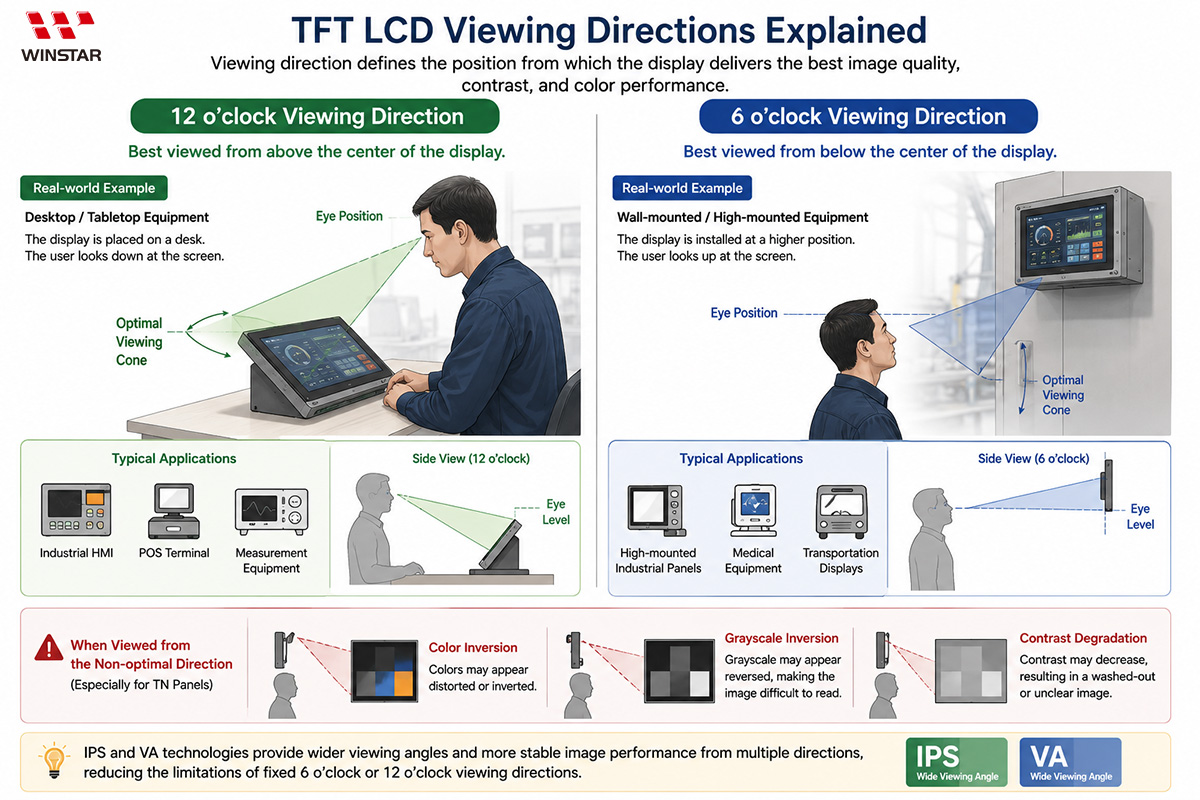
Figure 1. 6 o’clock and 12 o’clock viewing directions indicate the optimal viewing position relative to the center axis of the TFT LCD panel.
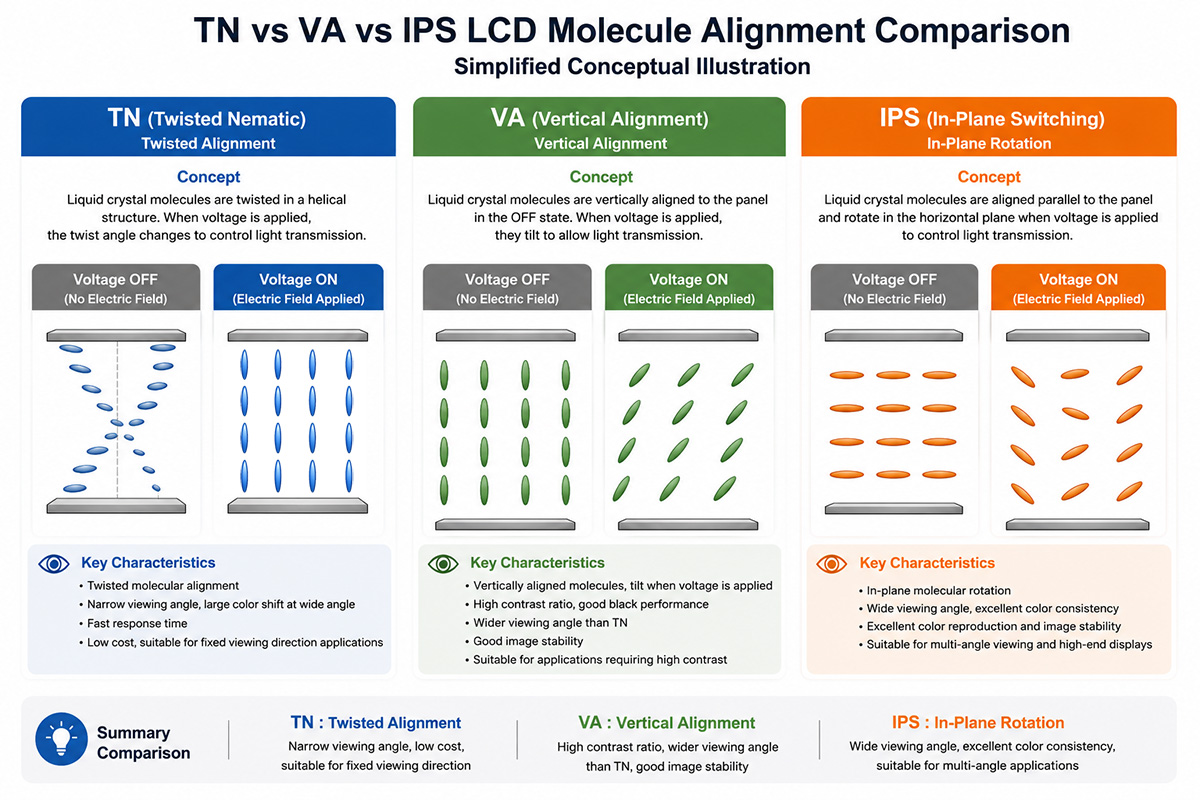
TN TFT LCD Technology
Viewing Characteristics
TN (Twisted Nematic) is one of the most widely used TFT LCD technologies and has been adopted in industrial displays for many years. Traditional TN TFT LCD panels are typically designed with a fixed viewing direction, such as 6 o'clock or 12 o'clock.
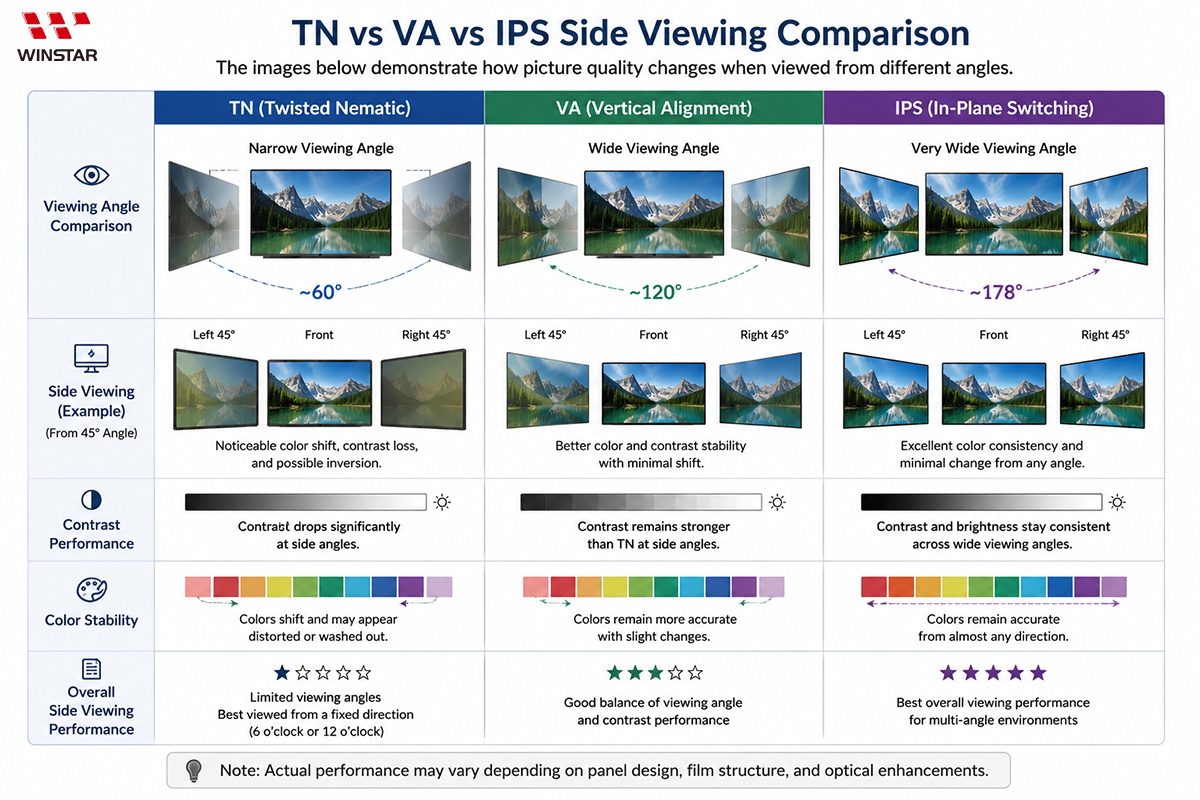
Compared with VA and IPS technologies, TN displays usually have narrower viewing angles and are more sensitive to viewing position changes. When viewed outside the optimal direction, image quality may be affected by grayscale inversion, contrast shifts, or color distortion.
However, TN technology remains widely used in industrial and embedded systems due to its mature manufacturing structure, fast response characteristics, and cost advantages.
Advantages
- Mature and widely available TFT LCD technology
- Lower production cost compared with VA and IPS panels
- Fast response characteristics suitable for dynamic content
- Lower power consumption in some applications
- Suitable for products with fixed viewing positions
Limitations
- Narrower viewing angles compared with VA and IPS technologies
- More sensitive to viewing direction and installation position
- Possible grayscale inversion or color shifting outside the optimal viewing angle
- Limited color consistency across multiple viewing positions
Typical Applications
TN TFT LCD displays are commonly used in applications with fixed viewing positions and cost-sensitive design requirements.
Typical applications include:
- Industrial control panels
- Handheld instruments
- Measurement equipment
- Home appliances
- Entry-level embedded systems
- Compact HMI devices
VA TFT LCD Technology
Viewing Characteristics
VA (Vertical Alignment) TFT LCD technology provides wider viewing angles and higher contrast ratios than traditional TN displays. In the default state, VA panels align liquid crystal molecules vertically, helping reduce light leakage and improve black level performance.
Compared with TN technology, VA TFT LCD displays maintain more stable image quality across wider viewing positions and are less affected by fixed viewing direction limitations. VA technology is especially valued for its high contrast and deeper black appearance.
VA TFT LCD modules are often used in industrial applications that require improved readability, high contrast, and stable visual performance, while offering a lower cost structure than IPS panels in many applications.
Advantages
- Wider viewing angles compared with TN TFT LCD technology
- Higher contrast ratio and improved black level performance
- Better image stability across different viewing positions
- Reduced grayscale inversion effects
- Suitable for industrial environments requiring high readability
Limitations
- Viewing angle performance may still be narrower than IPS technology in some conditions
- Response characteristics may vary depending on panel structure
- Color consistency may differ slightly at extreme viewing angles
Typical Applications
VA TFT LCD displays are commonly used in applications that require high contrast and stable viewing performance.
Typical applications include:
- Industrial automation systems
- Outdoor equipment
- Measurement instruments
- Portable industrial devices
- Medical equipment
- Smart control panels
IPS TFT LCD Technology
Viewing Characteristics
IPS (In-Plane Switching) TFT LCD technology provides wide viewing angles and stable color performance across multiple viewing positions. Unlike traditional TN structures, IPS panels rotate liquid crystal molecules parallel to the display surface, helping maintain image quality when viewed from different directions.
IPS technology is widely recognized for its wide viewing angle characteristics, color consistency, and stable grayscale performance. Compared with TN and VA technologies, IPS TFT LCD displays could be viewed in various angles. With viewing angles reaching up to 89/89/89/89, stable image quality and readability from all directions, IPS TFT LCD displays are also known as “All View” displays in the industry.
IPS TFT LCD modules are widely used in industrial HMI systems, medical equipment, transportation devices, and embedded applications where users may interact with the display from multiple angles.
Advantages
- Wide viewing angles with stable image performance
- Excellent color consistency across different viewing positions
- Reduced color shifting and grayscale inversion
- Suitable for multi-user viewing environments
- Improved readability for advanced HMI applications
Limitations
- Higher production cost compared with traditional TN panels
- Power consumption may vary depending on panel structure and brightness requirements
- Higher optical performance may increase system cost in some applications
Typical Applications
IPS TFT LCD displays are commonly used in applications that require stable viewing performance and consistent image quality.
Typical applications include:
- Industrial HMI systems
- Medical devices
- Transportation equipment
- Advanced embedded systems
- Smart devices
- High-end control interfaces
TN vs VA vs IPS Comparison Table
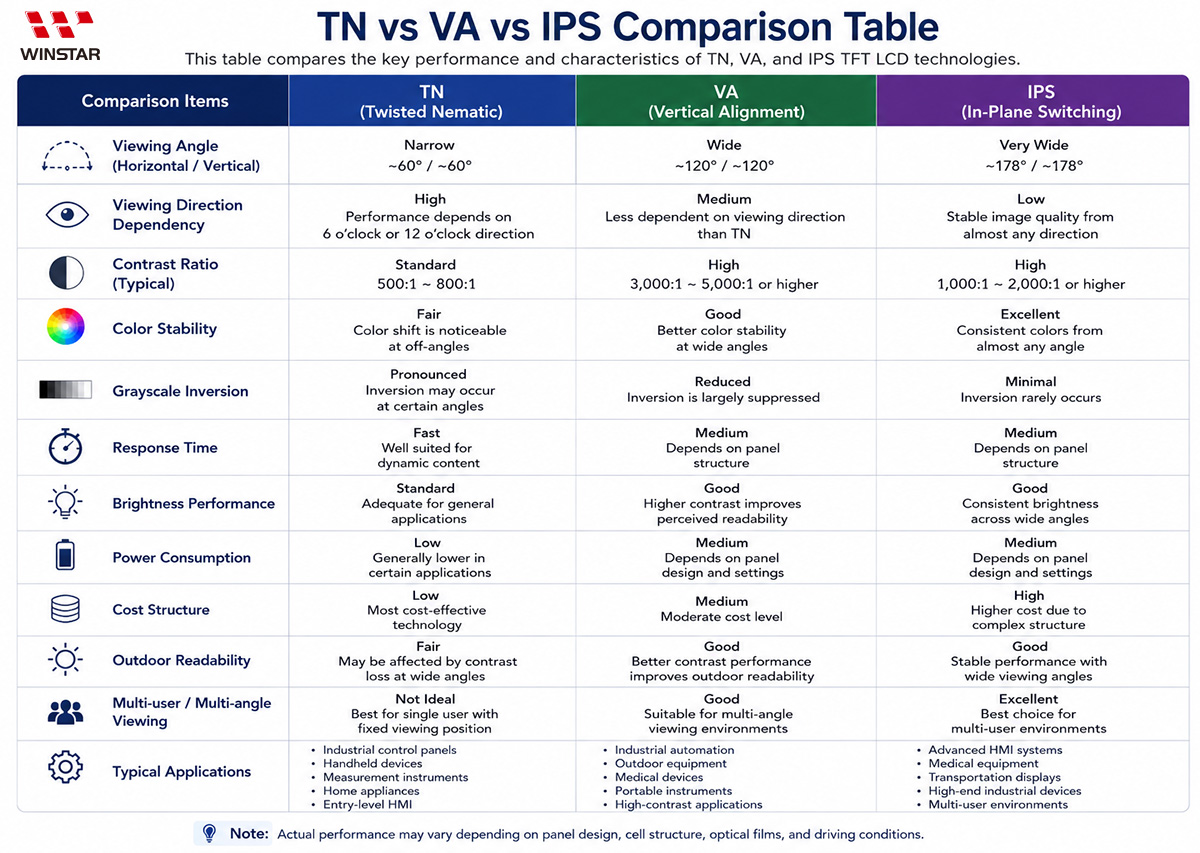
Choosing the Right TFT LCD Viewing Angle Technology
Selecting the most suitable TFT LCD viewing angle technology depends on the operating environment, viewing conditions, and system design priorities of the target application. Rather than defining TN, VA, or IPS as universally better, each display mode offers different advantages.
TN TFT LCD technology remains a practical solution for products with fixed viewing positions and cost-sensitive designs. With its mature panel structure and fast response characteristics, TN displays are widely used in industrial control systems, handheld instruments, home appliances, and entry-level embedded devices where users typically view the display from a specific direction.
VA TFT LCD technology is often selected for applications that require high contrast and stable readability across wider viewing positions. Compared with TN panels, VA displays offer higher contrast ratios and reduced grayscale inversion, making them suitable for industrial automation equipment, outdoor devices, smart control systems, and measurement instruments.
IPS TFT LCD technology is commonly adopted in advanced HMI systems and multi-angle viewing environments. Its stable color performance and wide viewing angle characteristics help maintain consistent image quality from different viewing directions. IPS displays are widely used in medical equipment, transportation systems, industrial HMIs, and embedded applications where multiple users or flexible installation positions are involved.
In actual product development, display selection should consider more than viewing angle performance alone. Contrast requirements, installation position, ambient lighting conditions, power consumption, interface integration, optical enhancements, and overall system cost can all affect the most suitable technology choice.
Understanding the characteristics of TN, VA, and IPS can help engineers and system designers select the display solution that best matches their application requirements.
TFT LCD Technology Selection Guide
| Application Requirement |
Suggested LCD Mode |
| Fixed viewing direction |
TN |
| Cost-sensitive designs |
TN |
| High contrast applications |
VA |
| Outdoor readability |
VA |
| Multi-angle viewing |
IPS |
| Advanced HMI systems |
IPS |
| Color-critical applications |
IPS |
| Portable industrial devices |
VA / IPS |
| General industrial equipment |
TN / VA |
| Medical and transportation systems |
IPS |
FAQ
1. What does 6 o'clock and 12 o'clock viewing direction mean?
6 o'clock and 12 o'clock viewing directions describe the optimal viewing position of a TFT LCD display.
A 12 o'clock viewing direction means the display is intended to be viewed from above the center of the panel, which is common for desktop or tabletop equipment. A 6 o'clock viewing direction means the display is optimized for viewing from below the center of the panel, which is often used in high-mounted equipment.
These viewing direction characteristics are more commonly associated with traditional TN TFT LCD technology.
2. What is the difference between 89/89/89/89 and 178° viewing angle?
In TFT LCD specifications, viewing angles are often measured separately for the left, right, up, and down directions. A specification such as 89/89/89/89 means the display can typically be viewed up to 89 degrees from each direction relative to the center axis of the panel.
Because the left and right viewing angles are commonly combined in specifications, 89° + 89° is often expressed as a 178° viewing angle. The same concept applies to the vertical viewing angle measurement.
3. Is IPS always better than TN or VA?
Not necessarily. Each TFT LCD technology provides different advantages depending on the application requirements.
IPS technology offers wide viewing angles and stable color performance, making it suitable for advanced HMI systems and multi-angle viewing environments. VA technology provides high contrast performance and improved readability, while TN technology remains a practical solution for cost-sensitive products and fixed viewing direction applications.
The most suitable display technology depends on the installation environment, viewing conditions, optical requirements, and system cost considerations.
4. When should I choose TN, VA, or IPS TFT LCD technology?
TN TFT LCD technology is suitable for fixed viewing positions and cost-sensitive applications.
VA TFT LCD technology is commonly used in applications requiring higher contrast and improved readability.
IPS TFT LCD technology is preferred for applications requiring wide viewing angles and stable image quality across multiple viewing positions.
The final display selection should be based on actual application requirements.
5. Does optical bonding improve TFT LCD viewing angle?
Optical bonding itself does not change the liquid crystal viewing angle characteristics of TN, VA, or IPS technologies.
However, optical bonding can improve overall display readability by reducing internal reflections and improving contrast performance, especially in outdoor or high ambient light environments.
As a result, the overall viewing experience may improve even though the TFT LCD mode itself remains unchanged.
6. How do I choose the right TFT LCD technology for industrial applications?
Choosing the right TFT LCD technology depends on multiple factors, including viewing angle requirements, installation position, contrast performance, ambient lighting conditions, power consumption, interface integration, and overall system cost.
TN, VA, and IPS technologies each provide unique advantages for industrial display applications. Understanding these characteristics can help engineers and system designers select the most suitable display solution for their products.