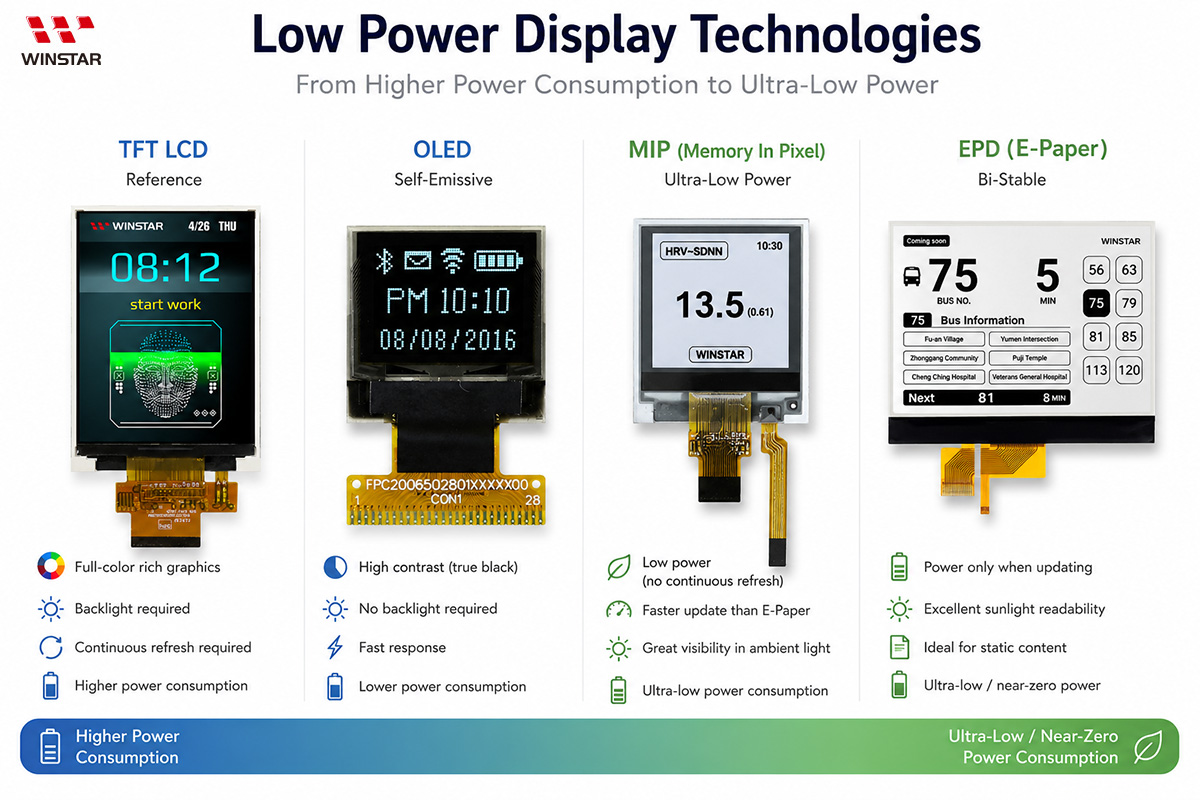
In many embedded systems, TFT LCD is often used as a baseline due to its versatility and full-color capability. However, its continuous refresh and backlight requirements can result in higher power consumption, leading designers to evaluate alternative low power display technologies.
As power efficiency becomes a key consideration in modern electronic systems, display selection is no longer based on visual performance alone. Technologies such as OLED, E-paper (EPD), and MIP (Memory in Pixel) each offer different approaches to reducing power consumption.
This article provides a structured overview of these display technologies, focusing on how power is consumed, where energy savings come from, and which applications they best support.
How Display Power Consumption Works
Display power consumption typically comes from two main sources:
- Backlight or emission source
- Image refresh and driving method
Different technologies reduce power consumption by optimizing one or both of these factors.
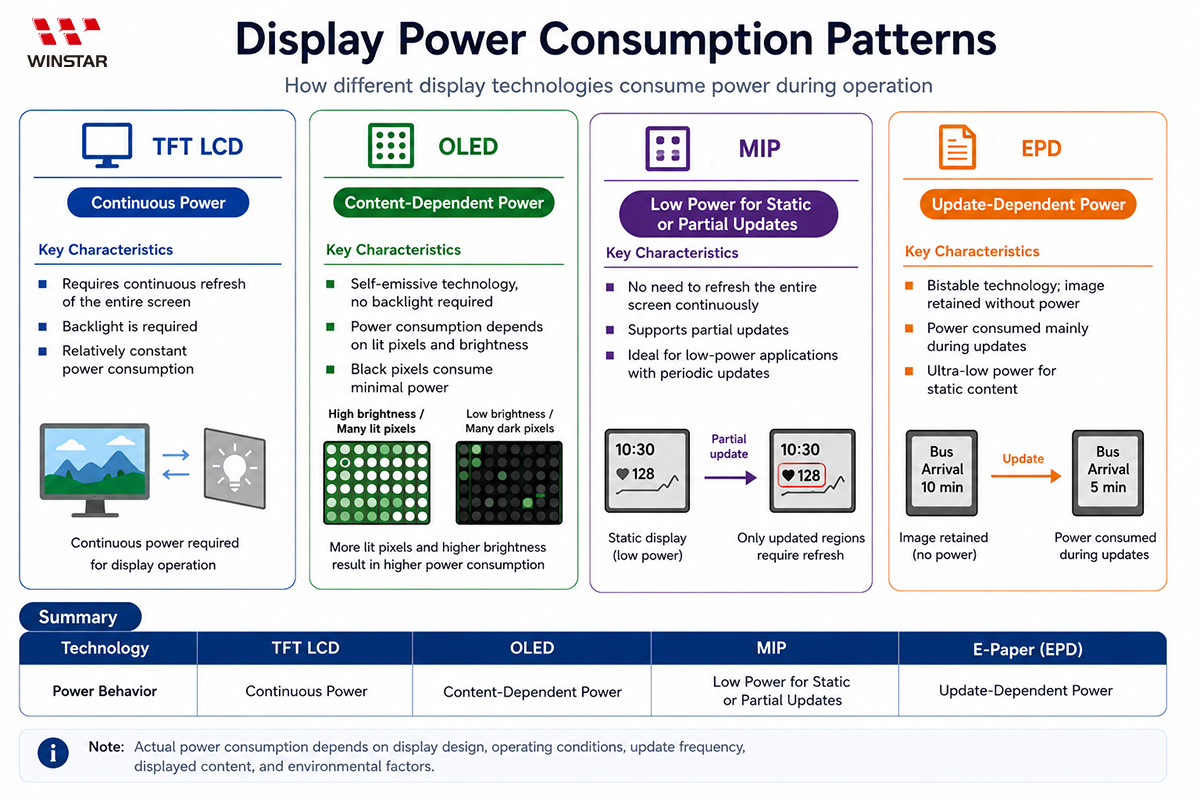
The diagram below provides a simplified comparison of how TFT LCD, OLED, E-Paper, and MIP displays consume power during operation.
TFT LCD as a Reference Point
TFT LCD is widely used in embedded and industrial systems due to its full-color capability and support for dynamic content. However, its power consumption model differs significantly from that of low power display technologies.
Power Characteristics of TFT LCD
- Requires continuous refresh regardless of content
- Backlight remains on during operation
- Power consumption is relatively constant
For systems with strict power budgets or mostly static content, this operating model may not be ideal. This is especially true in applications where display content changes infrequently, but power is still continuously consumed by refresh and backlight operation.
OLED Displays (Self-Emissive Technology)
Power-saving mechanism
- No backlight required
- Power consumption depends on pixel brightness
- Black pixels consume almost no power
Advantages
- High contrast (true black)
- Fast response time
- Suitable for dynamic content
Limitations
- Power increases with bright or full-screen content
- Lifetime considerations (burn-in risk in some cases)
Typical applications
- HMI interfaces with dark UI
- Audio equipment displays
- Industrial control panels with dark UI
- Compact information displays
MIP Displays (Memory in Pixel Technology)
Power-saving mechanism
- Each pixel stores its own data (no continuous refresh needed)
- Reflective / transflective design reduces backlight usage
Advantages
- Low power consumption (especially for static or partial updates)
- Faster update than EPD
- Better balance between power and interactivity
Limitations
- Lower contrast than OLED
- Limited color performance compared to TFT
Typical applications
- Portable instruments
- Wearable devices
- Industrial handheld systems
MIP displays provide a balance between ultra-low power operation and moderate refresh capability, making them suitable for applications that require both visibility and limited interactivity.
Although E-Paper typically provides the lowest power consumption for static content, MIP displays may offer better overall efficiency in applications requiring periodic updates or partial refreshes.
E-Paper Displays (Bi-Stable Technology)
Power-saving mechanism
- Bi-stable operation allows the displayed image to be retained without continuous power
- Power is consumed primarily during image update cycles
- An optional front light may be added for low-light viewing, with additional power consumption
Advantages
- Ultra-low power consumption
- Excellent sunlight readability
- Ideal for static content
Limitations
- Very slow refresh rate compared with OLED or TFT
- Limited color performance, depending on panel type
- Not suitable for highly interactive or fast-changing UI
Typical applications
- Electronic Shelf Labels (ESL)
- E-Readers
- Smart Retail Displays
- Medical and Healthcare Devices
- Public Transportation Information Displays
- Industrial Status and Monitoring Displays
Display Technology Comparison at a Glance
| Feature |
TFT LCD |
OLED |
EPD |
MIP |
| Power Model |
Relatively constant |
Content-dependent |
Primarily update-dependent |
Low power with static or partial updates |
| Refresh Behavior |
Continuous refresh |
Continuous refresh |
No continuous refresh |
No continuous refresh |
| Structure Type |
Transmissive LCD with backlight |
Self-emissive |
Reflective |
Reflective / transflective |
| Update Speed |
Fast |
Fast |
Very slow |
Faster than EPD |
| Sunlight Readability |
Limited to moderate |
Limited to moderate |
Excellent |
Excellent |
| Best Suited For |
Dynamic full-color UI |
High-contrast graphic or information displays |
Ultra-static content |
Low-power interfaces with moderate updates |
Display Selection Matrix
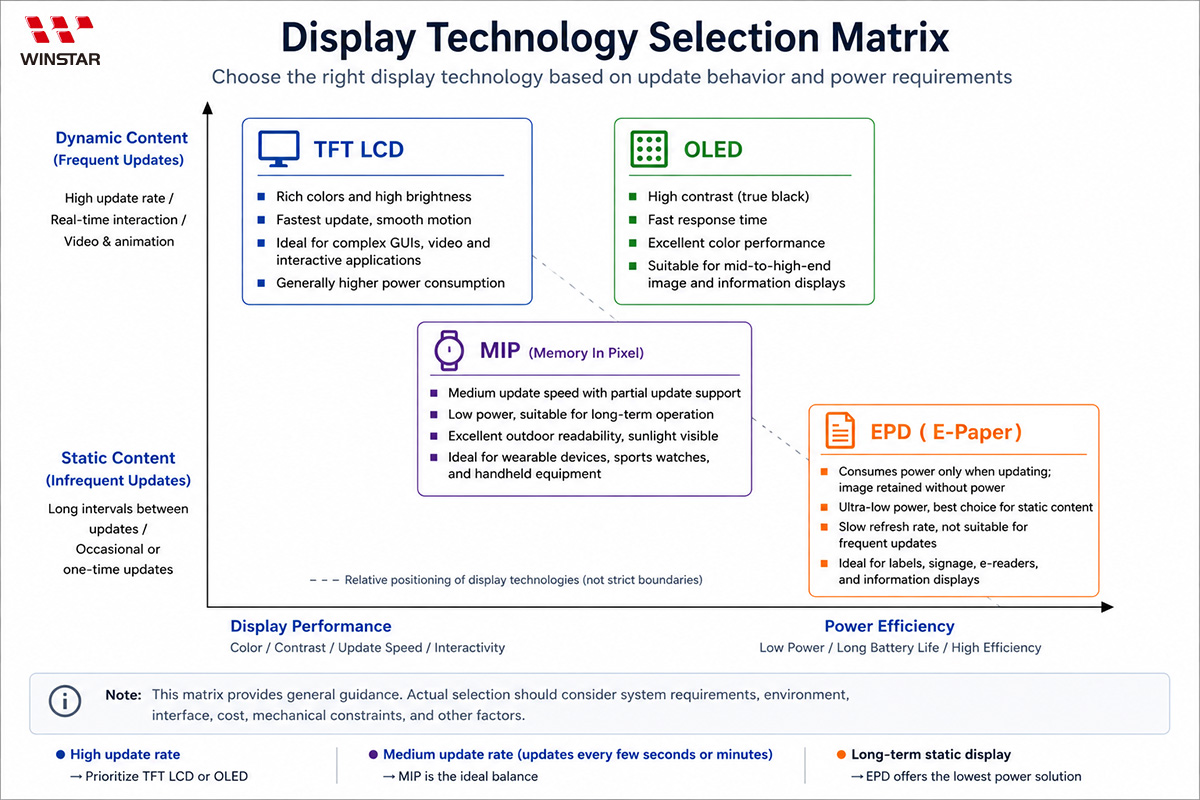
The matrix below provides a simplified view of how different display technologies align with application requirements. Rather than focusing on specifications alone, designers should consider update frequency, visual requirements, and power consumption priorities when selecting a display technology.
Choosing the Right Technology
Instead of comparing specifications alone, display selection should be based on actual system behavior:
- Choose TFT LCD for color graphical interfaces, rich visuals, and dynamic display content
- Choose OLED for high-contrast, fast-response, compact graphic or information displays
- Choose EPD for ultra-static, ultra-low-power applications
- Choose MIP for a balance between power efficiency and basic refresh capability
How to Select the Right Low Power Display
Selecting the right low power display depends on how the system is used in practice. Factors such as update frequency, viewing environment, interface complexity, and power budget all influence which technology is the better fit.
Rather than asking which display is best overall, it is more useful to identify which technology best matches the operating behavior of the target application.
Frequently Asked Questions
Q1: Is E-Paper more power efficient than MIP?
E-Paper typically provides the lowest power consumption for static content. However, in applications requiring periodic updates or partial refreshes, MIP may offer better overall power efficiency.
Q2: Can MIP displays replace TFT LCDs?
MIP displays are not designed to replace TFT LCDs in dynamic applications such as video or complex GUI systems. They are better suited for low-refresh, power-sensitive systems.
Q3: Does OLED always consume less power than TFT?
Not always.
OLED power consumption depends on the displayed content. In many typical use cases, where the lit area is relatively small, OLED can be more power efficient than TFT LCD. For example, when the lit area is less than 20% of the total display area, OLED may consume less power. However, when displaying high-brightness or predominantly white content, OLED power consumption may exceed that of TFT LCD.
Q4: Which display technology is best suited for outdoor use?
E-Paper (EPD) and MIP displays generally provide better readability under sunlight, making them suitable for outdoor or high ambient light applications. TFT and OLED displays may require higher brightness to maintain readability in similar conditions.
Q5: Can E-Paper display video or real-time animation?
No. E-Paper has a relatively slow refresh rate and is mainly suitable for static information display. For real-time animation or smooth content updates, TFT, OLED, or MIP is usually a better choice.
Q6: What is the difference between MIP and E-Paper?
Both MIP and E-Paper are low power display technologies, but MIP supports faster image updates and is better suited for real-time data display. E-Paper is more suitable for maintaining static content over long periods.
Q7: How do MIP and E-Paper perform differently in low-temperature environments?
The refresh speed of E-Paper displays is more likely to be affected by low temperatures, which may result in slower image updates in cold environments. MIP displays typically support wider operating temperature ranges while maintaining more consistent refresh performance, making them suitable for industrial and outdoor applications that require both low power consumption and real-time data display.
Q8: Do E-Paper displays require a light source at night?
Yes. E-Paper is not self-emissive and mainly relies on reflected ambient light to display content. In low-light or nighttime environments, a front light module is usually required for clear readability.