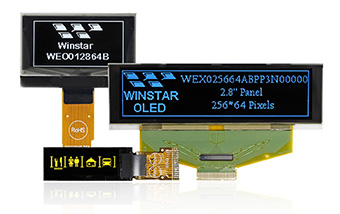
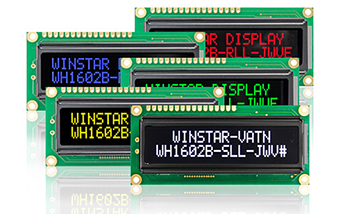
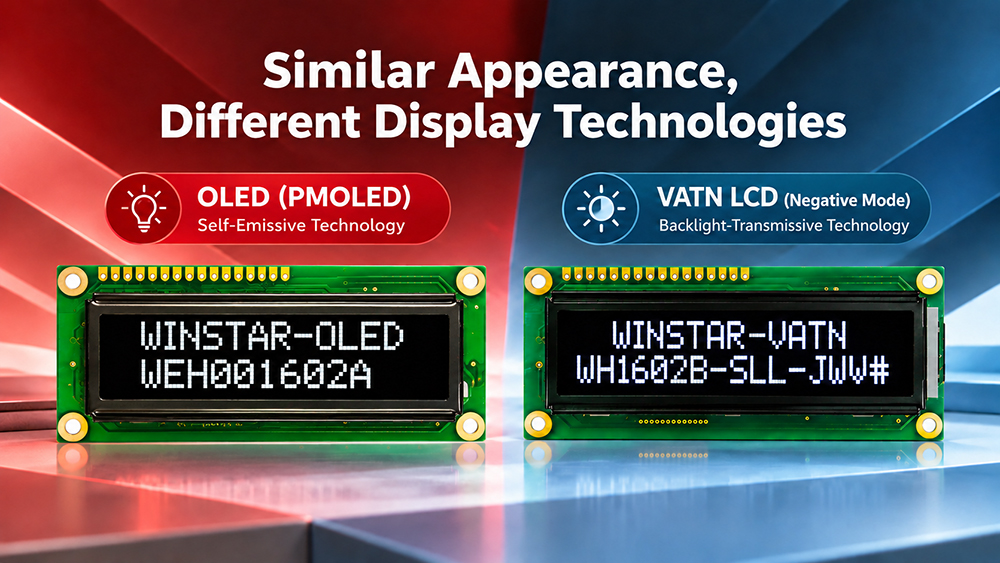
In industrial control equipment, instrumentation, and embedded systems, displays with bright characters on a black background are commonly used to show equipment status, operating information, and monitoring data. Both monochrome PMOLED and negative-mode VATN LCD can provide this appearance, but they differ fundamentally in how they produce an image: PMOLED pixels emit light directly, while VATN LCD controls the transmission of light from an LED backlight.
This difference also affects display performance, power consumption, and long-term operation. For equipment that displays static information for extended periods or frequently updates text and graphics, these characteristics can influence the choice of display technology.
This article compares the operating principles, display performance, module thickness and construction, power consumption, service life considerations, and operating temperature characteristics of monochrome PMOLED and VATN LCD. It also examines the key factors engineers should evaluate when selecting display modules for industrial applications.
On This Page
- How Do OLED and VATN LCD Technologies Work?
- Display Performance and Module Construction
- Power Consumption and Driving Requirements
- Operating Lifetime and Static Image Considerations
- Operating Temperature and Environmental Considerations
- How to Choose Between OLED and VATN LCD for Industrial Applications
- Frequently Asked Questions About OLED and VATN LCD
How Do OLED and VATN LCD Technologies Work?
OLED and VATN LCD can both produce bright characters against a dark background, but they generate the visible image differently. OLED pixels emit light directly, while VATN LCDs control the transmission of light from a backlight.
OLED (Organic Light-Emitting Diode) is a self-emissive display technology in which electrical current causes organic materials to emit light without a separate backlight. WINSTAR monochrome PMOLED (Passive-Matrix OLED) displays use row-and-column scanning to control pixels, allowing text, numbers, and graphics to be displayed in a dot-matrix format. Because unlit pixels do not emit light, PMOLED can produce deep blacks and high contrast between the background and illuminated content.
VATN LCD (Vertical Alignment Twisted Nematic Liquid Crystal Display) is a non-emissive technology that uses voltage to change the orientation of liquid crystal molecules and control light transmission through the display. The negative-mode VATN LCDs discussed in this article typically use LED backlighting. Areas without displayed content appear dark, while areas displaying characters or symbols allow backlight to pass through, creating bright content against a dark background.
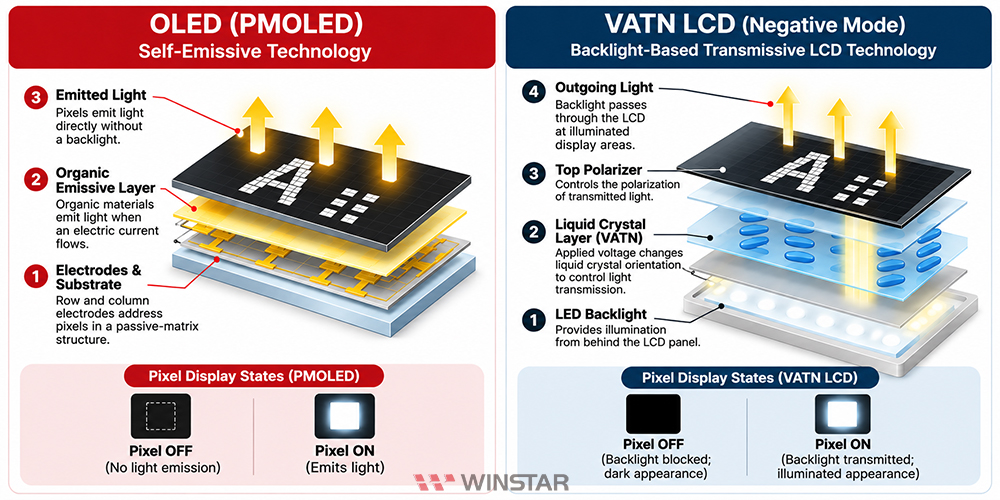
Figure 1. Operating principles of PMOLED and negative-mode VATN LCD.
Display Performance and Module Construction
Contrast Ratio
Both PMOLED and VATN LCD can display bright characters against a dark background. However, they produce the dark background differently, which affects their contrast performance.
In monochrome PMOLED displays, unlit pixels do not emit light, producing deep blacks and generally high contrast under dark-room conditions. VATN LCDs control the transmission of backlight through the liquid crystal layer. Some light leakage may remain in non-display areas, so black levels and contrast depend on the liquid crystal materials, polarizers, and backlight design.
However, higher contrast does not always mean better readability. For example, when a display is installed in an area exposed to strong ambient light, display brightness and surface reflections can affect how clearly characters can be seen. Dark-room contrast and readability under actual lighting conditions should therefore be evaluated separately.
Viewing Angle
Viewing angle determines how clearly operators can read display content from different directions.
PMOLED displays typically offer a wide viewing angle of 160°, maintaining good readability when viewed from the side or from different positions. In VATN LCDs, contrast may change with viewing direction, depending on the liquid crystal materials and optical design.
For example, a display mounted high or low on an equipment rack may need to be viewed from above or below. In such cases, the specified viewing angle alone may not be sufficient; contrast at the actual viewing position is also important.
Response Time
Response time describes how long a display element takes to change from one display state to another. It affects how clearly changing content appears on the screen.
PMOLED pixels generally respond faster, reducing the likelihood of motion blur caused by pixel switching when text, numerical readings, or graphics change rapidly. VATN LCDs rely on liquid crystal molecules changing orientation, which typically takes longer. Response times may increase further at low operating temperatures.
For equipment that mainly displays fixed characters or information that changes infrequently, a longer response time may have little practical impact. However, applications requiring rapid updates or frequent screen changes should consider both the display element's response time and the module's actual refresh capability.
Module Thickness and Construction
Monochrome PMOLED displays use self-emissive technology and do not require a separate backlight module, providing an advantage in thin-profile display designs. The VATN LCDs discussed in this article require LED backlighting, so their overall thickness is influenced by the backlight structure and module design.
However, the thickness of a complete display module depends not only on the panel and backlight structure but also on the PCB, driver components, connectors, and other mechanical design elements. Although PMOLED has an advantage in thin-profile designs because it does not require a backlight, actual module thickness must be verified for each model.
For industrial equipment with limited installation space, engineers should compare the overall module thickness, external dimensions, and mounting requirements of specific models to ensure compatibility with the equipment's mechanical design.
Power Consumption and Driving Requirements
Power Consumption
PMOLED and VATN LCD have different power consumption characteristics, particularly in how displayed content affects the power required for illumination.
In monochrome PMOLED displays, power consumption depends on the number of illuminated pixels and display brightness. For example, displaying a few characters or numbers requires fewer illuminated pixels, while larger graphics or higher brightness settings increase power consumption. As a result, the same PMOLED module may consume different amounts of power depending on the displayed content.
In VATN LCDs, the LCD driving circuitry typically consumes relatively little power, while the LED backlight can account for a significant portion of total module power. Because the backlight generally illuminates the entire display area, displaying fewer characters does not reduce backlight power in the same way as reducing illuminated pixels in a PMOLED. Backlight brightness, drive current, and operating duration are the main factors affecting overall power consumption.
Neither technology is necessarily more power-efficient in every application. For equipment that continuously displays limited information or periodically turns off the display or backlight, actual power consumption may differ considerably. Total module power should therefore be compared under equivalent operating conditions.
Driving Requirements
Both PMOLED and VATN LCD require appropriate driving circuitry, but they differ in how display content and power are controlled.
WINSTAR monochrome PMOLED modules incorporate controller/driver ICs depending on the model. These ICs handle pixel scanning and display control, while the host MCU sends commands and display data through SPI, I²C, or another supported interface. Some modules include internal voltage boosting, while others use an externally supplied display driving voltage. Power configuration and controller settings therefore depend on the selected module.
VATN LCDs require AC driving signals and appropriate bias conditions to control the liquid crystal state. Modules with LED backlighting also require consideration of backlight power and brightness control.
For system integration, PMOLED designs require verification of the controller interface and display supply requirements, while VATN LCD designs require attention to LCD driving and backlight circuitry. The actual circuit configuration depends on the integration level of the selected module, so neither technology should be assumed to be simpler to implement in every case.
Operating Lifetime and Static Image Considerations
Operating Lifetime
PMOLED and VATN LCD technologies have different lifetime characteristics, mainly because different components are responsible for luminance degradation.
Monochrome PMOLED displays use organic materials that emit light directly. Pixel luminance gradually decreases as operating hours accumulate. Higher brightness settings and longer illumination periods can accelerate the aging of these emissive materials.
VATN LCDs use LED backlighting as their light source. Backlight luminance also decreases over time, but this is a different aging mechanism from that of PMOLED pixels. The liquid crystal structure and other components have their own reliability limits, so the rated backlight lifetime does not represent the lifetime of the entire module.
When comparing lifetime specifications, it is important to determine whether the rating refers to PMOLED luminance degradation or VATN LCD backlight lifetime, and to check the test conditions used. The stated operating hours alone do not provide a direct comparison.
Static Image Considerations
Industrial equipment often displays fixed information for extended periods, such as equipment names, operating menus, status icons, or monitoring values. Both PMOLED and VATN LCD can display this information, but prolonged operation affects them differently.
Each PMOLED pixel emits its own light. When text or icons remain in the same position for long periods, the illuminated pixels accumulate more operating hours than surrounding pixels. This can lead to uneven luminance or permanent burn-in. Lowering display brightness, periodically shifting fixed icons, or turning off the display when it is not needed can help reduce differential pixel aging.
VATN LCDs use LED backlighting, so static content does not cause the same emissive-pixel differential aging seen in PMOLED displays. This gives VATN LCDs an advantage when displaying fixed characters or status information for extended periods. However, backlight luminance still decreases with use.
For equipment that continuously displays fixed information, VATN LCD is worth considering first. PMOLED offers greater flexibility in display content, but pixel aging in persistently illuminated areas should be considered during display design.
Operating Temperature and Environmental Considerations
Industrial equipment may be installed in outdoor enclosures, factory control systems, or environments with significant temperature variations. WINSTAR offers monochrome PMOLED and VATN LCD modules with wide operating temperature ranges, although temperature affects their display performance differently.
Most WINSTAR standard monochrome PMOLED modules operate from −40°C to +80°C, with storage temperatures from −40°C to +85°C. PMOLED displays generally maintain fast pixel response at low temperatures, although temperature can affect the luminance and electrical characteristics of organic emissive materials. Elevated temperatures may also accelerate material aging.
WINSTAR's current standard VATN LCD modules support operating temperatures from −20°C to +70°C and storage temperatures from −30°C to +80°C, meeting the wide-temperature requirements of many industrial applications. Because VATN LCDs use liquid crystal materials, low temperatures may slow display transitions, while high temperatures can affect contrast and overall display performance. Customized VATN LCD modules can support an operating temperature range of −30°C to +80°C and a storage temperature range of −40°C to +85°C.
In addition to the module specifications, the actual temperature inside the equipment is an important selection factor. For example, temperatures inside sealed enclosures may exceed the surrounding ambient temperature, so display performance should be evaluated under the equipment's actual operating conditions. Storage temperature ratings apply to non-operating conditions and do not indicate the range in which a module can function normally. Actual temperature specifications should be verified against the selected model's datasheet.
How to Choose Between OLED and VATN LCD for Industrial Applications
When choosing between monochrome PMOLED and VATN LCD, start with the information the equipment needs to display. WINSTAR's current standard VATN LCD products are mainly character modules, suited to fixed-format text, numerical readings, and equipment status information. For applications requiring graphics or flexible screen layouts, WINSTAR offers standard monochrome PMOLED graphic dot-matrix modules. VATN LCD modules can also be customized to display specific icons or predefined patterns, subject to customization requirements.
If standard modules cannot meet the required display format or mechanical specifications, both PMOLED and VATN LCD can be considered for customization. VATN LCD may offer advantages in design flexibility and tooling costs. However, actual feasibility and costs depend on the specifications and development requirements.
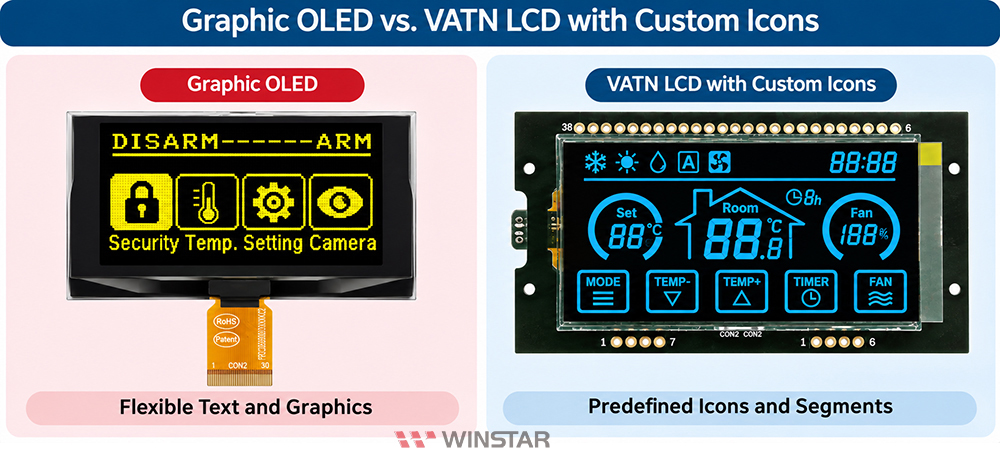
For equipment that displays fixed information for extended periods, VATN LCD is worth considering first if the display format of a standard or customized module meets the application requirements. If PMOLED is selected, display brightness and static image management should be addressed during the design stage to reduce differential pixel aging.
Once the display format and operating pattern are defined, compare the actual modules' operating temperature, power consumption, viewing angle, interface, and mechanical dimensions. For example, if equipment must operate at −30°C, engineers can consider standard PMOLED modules rated for that temperature or customized VATN LCD modules designed for an extended operating temperature range. However, VATN LCD response times may increase at low temperatures, so display update performance should be verified at the actual operating temperature to ensure it meets the application requirements.
WINSTAR offers OLED and VATN LCD modules for industrial equipment and embedded systems. Browse the product categories below to review available models, display specifications, and technical information.
〉WINSTAR OLED Display Modules
〉WINSTAR VATN LCD Display Modules
Frequently Asked Questions About OLED and VATN LCD
1. What is the difference between OLED and VATN LCD?
The main difference is how they produce the visible image. OLED is self-emissive, with pixels generating light directly without a backlight. VATN LCD controls light transmission from an LED backlight. Both can display bright content on a dark background, but they differ in contrast, response time, power consumption characteristics, and aging mechanisms during extended operation.
2. Which is better for displaying static information continuously, OLED or VATN LCD?
VATN LCD is worth considering for equipment that continuously displays fixed characters, status information, or predefined patterns. WINSTAR currently offers standard VATN LCD character modules. For applications requiring specific icons or predefined patterns, customized VATN LCD modules can also be considered. VATN LCDs do not experience the same differential aging of continuously illuminated emissive pixels as PMOLED displays. However, LED backlight lifetime still needs to be considered.
WINSTAR also offers standard monochrome PMOLED graphic dot-matrix modules, allowing display content and screen layouts to be adjusted through software. PMOLED can also be used in equipment designed for continuous operation, but display brightness and static image management should be considered.
3. Can VATN LCDs be customized with icons or fixed patterns?
Yes. WINSTAR's current standard VATN LCD products are mainly character modules. For applications requiring specific icons, symbols, or predefined patterns, customized VATN LCD solutions can be considered. The display content and layout of these customized designs must be defined during development, unlike graphic dot-matrix modules that allow individual pixels to be controlled through software.
4. Can an OLED module directly replace a VATN LCD module?
Not necessarily. Even if the two modules have a similar appearance, their mechanical dimensions, pin assignments, power requirements, control interfaces, and display formats may differ. Circuit, firmware, and mechanical compatibility must be checked before replacement. Similar screen size or appearance alone does not guarantee interchangeability.