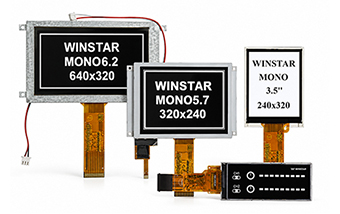
Monochrome LCDs are widely used in industrial and embedded applications where full-color graphics are not required. While traditional STN and DFSTN LCDs have long been common choices for monochrome displays, some applications require the faster response and improved display performance of TFT technology without the need for full-color graphics. Monochrome TFT LCDs address these requirements by combining TFT performance with monochrome display simplicity.
Unlike conventional passive-matrix monochrome LCDs, a monochrome TFT LCD uses an active-matrix TFT structure to control individual pixels. This allows monochrome TFT displays to combine the simplicity of monochrome content with key performance advantages associated with TFT technology.
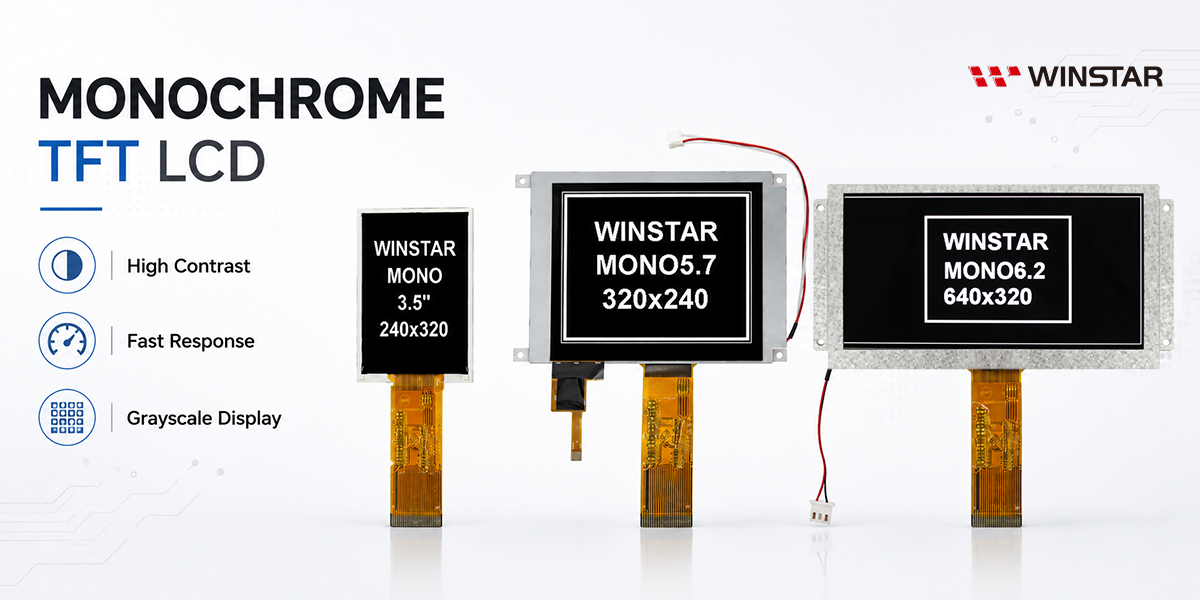
Monochrome TFT vs. STN and DFSTN LCD
Traditional STN LCDs are well suited for many monochrome applications, particularly where simple display content and low system complexity are required. However, their passive-matrix structure can limit contrast and response performance compared with active-matrix TFT displays.
DFSTN (Double Film Super-Twisted Nematic) technology improves the visual performance of conventional STN LCDs and can provide a dark background appearance with light characters or graphics. In some applications, however, the dark background may exhibit a slightly purplish appearance rather than a neutral black.
Monochrome TFT technology provides an alternative for applications that require a deeper dark background, higher contrast, and faster response. Depending on the panel and module design, monochrome TFT displays can achieve contrast ratios of approximately 800:1 to 900:1, providing clear and well-defined monochrome images.
High Contrast Display Performance
Monochrome TFT LCDs provide clear monochrome image presentation with strong contrast between the displayed content and background. Depending on the application design, the display can be presented with dark characters on a light background or bright characters on a dark background to achieve clear and readable information display.
The high contrast performance of monochrome TFT LCDs makes them suitable for industrial and embedded applications where clear visibility and simple graphical information are required.
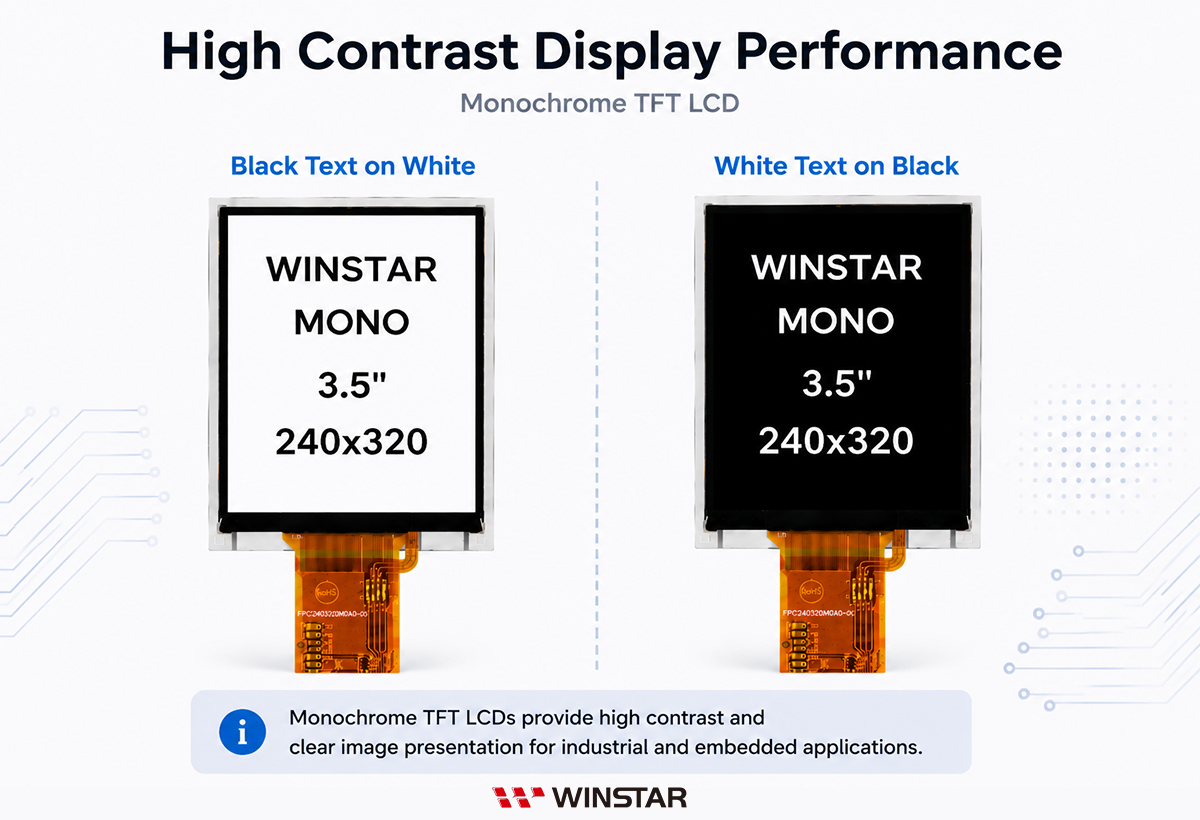
Figure 1. High contrast display examples using WINSTAR monochrome TFT LCDs.
Advantages of Monochrome TFT LCD Displays
By combining monochrome display content with an active-matrix TFT structure, monochrome TFT LCDs offer several advantages over traditional passive-matrix monochrome LCD technologies:
- Fast response: TFT technology provides faster pixel response than conventional passive-matrix STN LCDs, making it suitable for applications requiring quick display updates.
- High contrast: Active-matrix pixel control enables clear separation between dark and bright display areas.
- Clear monochrome image quality: The display provides sharp characters, icons, and graphics for industrial user interfaces.
- Grayscale support: Depending on the driver configuration and module, the display can support monochrome, 4-level grayscale, or 16-level grayscale operation.
- MCU-friendly integration: Selected modules support direct connection to MCU-based systems without requiring an additional external display controller board.
Interface and Grayscale Options
Monochrome TFT modules can be integrated into embedded systems using commonly used MCU interfaces. Depending on the module and driver IC, available communication interfaces may include 3-line or 4-line serial interfaces as well as an 8-bit parallel interface compatible with 8080 or 6800 systems.
Different grayscale modes can also be selected according to the application requirements and driver configuration. Monochrome, 4-level grayscale, and 16-level grayscale modes allow designers to balance display content, visual detail, and system requirements without introducing the complexity of a full-color graphical interface.
When to Choose a Monochrome TFT Display
A monochrome TFT LCD can be a practical choice when an application does not require full-color graphics but still needs better display performance than a conventional monochrome STN LCD can provide. Its combination of high contrast, fast response, and grayscale capability makes the technology suitable for industrial equipment, control systems, instrumentation, measurement devices, and other embedded applications that rely on clear and responsive visual information.
For applications currently using STN or DFSTN displays, monochrome TFT technology may therefore be considered as an alternative when higher display performance is required.
WINSTAR Monochrome TFT LCD Solutions
WINSTAR offers monochrome TFT LCD modules for embedded and industrial display applications. Available specifications, grayscale modes, interfaces, contrast performance, and other characteristics vary by model, allowing designers to select a display according to their system and application requirements.
Explore WINSTAR Monochrome TFT LCD Modules
Monochrome TFT LCD FAQs
1. What is the difference between a monochrome TFT and an STN LCD?
The main difference is the display driving structure. A monochrome TFT uses an active-matrix TFT structure to control individual pixels, while a conventional STN LCD uses a passive-matrix structure. As a result, monochrome TFT displays can provide higher contrast and faster response than traditional STN LCDs. STN LCDs remain suitable for many simple monochrome applications, while monochrome TFT is a useful option when improved display performance is required.
2. Can a monochrome TFT replace an STN or DFSTN LCD?
A monochrome TFT can be considered as an alternative to an STN or DFSTN LCD, particularly when higher contrast, faster response, or a darker background is required. However, it is not necessarily a direct drop-in replacement. Mechanical dimensions, resolution, interface, pin assignment, operating voltage, power requirements, display characteristics, and system compatibility should all be evaluated before replacement.
3. Why choose a monochrome TFT instead of a color TFT?
A monochrome TFT can be a practical choice when an application does not require full-color graphics but still needs the fast response, contrast performance, and pixel control provided by TFT technology. It allows designers to achieve clear monochrome display performance while maintaining the advantages of TFT-based display technology.
4. Can a monochrome TFT be driven directly by an MCU?
Yes, selected monochrome TFT modules can be connected directly to an MCU without requiring an additional external display controller board. Depending on the module and driver IC, available interfaces may include 3-line or 4-line serial interfaces and 8-bit parallel interfaces compatible with 8080 or 6800 systems. The interface and driving requirements should always be confirmed from the specifications of the selected module.
5. Can a monochrome TFT display grayscale images?
Yes. Monochrome does not necessarily mean that the display is limited to only black and white. Depending on the module, driver IC, and configuration, a monochrome TFT can support monochrome, 4-level grayscale, or 16-level grayscale. Grayscale capability allows additional visual levels to be used for icons, graphics, status information, and other interface elements without requiring a full-color display.