Brightness and Power Consumption Considerations for Outdoor TFT LCDs
Outdoor LCD displays are used in applications such as ATMs, EV charging stations, smart parcel lockers, bus information displays, handheld industrial measurement instruments, and marine navigation equipment. In outdoor environments, these displays need to maintain adequate visibility under varying ambient lighting conditions.
For outdoor displays using conventional RGB TFT LCDs, increasing display brightness typically requires higher backlight output, which presents three major design challenges:
- Display Brightness and Outdoor Visibility: Under strong ambient light, reflections from the display surface reduce the apparent contrast of the image, making displayed information more difficult to read. To maintain readability and contrast in sunlight, outdoor displays often require brightness levels of 800 to 1000 cd/m² or higher. Actual visibility also depends on factors such as ambient illuminance, panel reflectance, and contrast ratio.
- Backlight Power Consumption and Battery Runtime: Conventional RGB LCD panels have limited light transmittance. Increasing display brightness without changing the LCD panel typically requires a higher LED drive current, which increases both backlight output and power consumption. For battery-powered outdoor handheld instruments and portable devices, higher backlight power consumption reduces battery runtime if battery capacity and other system power requirements remain unchanged.
- Thermal Management and Component Reliability: Increasing the LED backlight drive power generates more heat within the backlight assembly and increases the thermal load on the system. Prolonged exposure to high temperatures can accelerate LED lumen depreciation and aging, reducing backlight service life. Optical materials such as polarizers may also degrade at elevated temperatures. If the temperature of the liquid crystal material exceeds its specified operating range, reduced contrast or other display abnormalities may occur.
Achieving higher display brightness while keeping power consumption and heat generation under control is a key design challenge for outdoor display equipment.
RGBW LCD Pixel Structure and Optical Principles
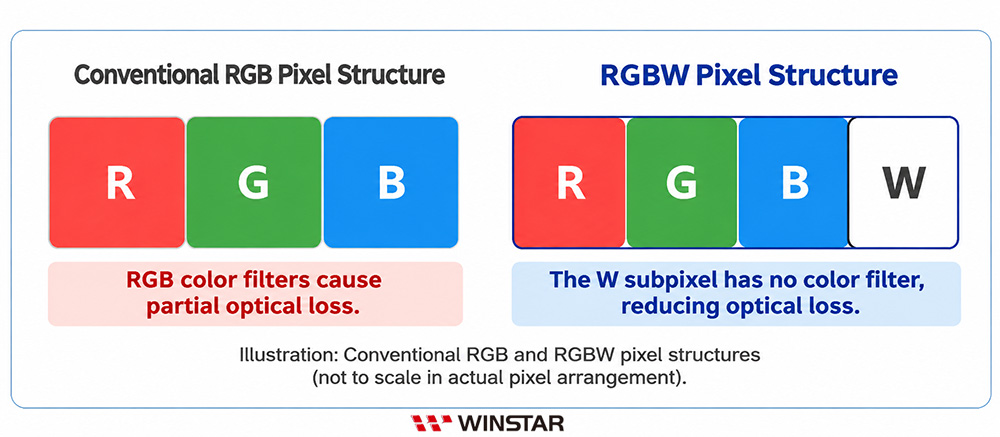
In a conventional RGB LCD, each pixel consists of three subpixels: red (R), green (G), and blue (B). When white light from the backlight passes through the color filter of each subpixel, only specific wavelength bands are transmitted, while other wavelengths are absorbed. Additional optical losses associated with the polarizers, liquid crystal layer, and pixel aperture ratio further limit the amount of light transmitted through the LCD cell. For example, the WF50F RGB LCD cell used in this comparison has a light transmittance of 4.8%, including the polarizers.
RGBW LCD technology adds a white (W) subpixel to the conventional red, green, and blue subpixel structure. Since the W subpixel does not require an RGB color filter, it reduces the optical losses associated with color filtering and allows more of the white light from the backlight to pass through the LCD cell.
Optical Characteristics of RGBW LCDs
- Higher Light Transmittance: The white (W) subpixel does not use a color filter, allowing white light from the backlight to pass through the LCD cell with reduced color filtering losses, thereby increasing light transmittance.
- Brightness Benefits for White and Light-Colored Content: When outdoor user interfaces display white backgrounds, maps, charts, or light-colored text, the W subpixel can contribute to the luminance of the displayed content. By allowing white light to pass through without RGB color filtering, the RGBW LCD makes more efficient use of the backlight and can increase the brightness of such content.
- Higher Brightness at the Same Backlight Power: Under comparable backlight design and test conditions, an RGBW LCD can achieve higher display brightness at the same backlight power consumption due to its higher light transmittance, helping improve visibility in sunlight. Conversely, backlight output can be reduced to lower power consumption while maintaining the same target brightness.
RGB vs. RGBW LCD: Optical Performance and Backlight Power Consumption
To evaluate the benefits of RGBW technology for high-brightness outdoor displays, we compared a conventional RGB LCD (WF50F) with an RGBW LCD (WFN0500A4). The comparison is based on optical specifications and measured backlight power consumption, focusing on differences in light transmittance, contrast ratio, and backlight power requirements at different brightness levels.
Optical Performance Comparison
| Optical Parameter |
Conventional RGB LCD Cell (WF50F) |
RGBW LCD Cell (WFN0500A4) |
Comparison |
| Light Transmittance (Typ.) |
4.8% |
8.0% |
Increase of 3.2 percentage points |
| Contrast Ratio (Typ.) |
1000:1 |
1500:1 |
50% increase in contrast ratio |
Original Optical Specifications
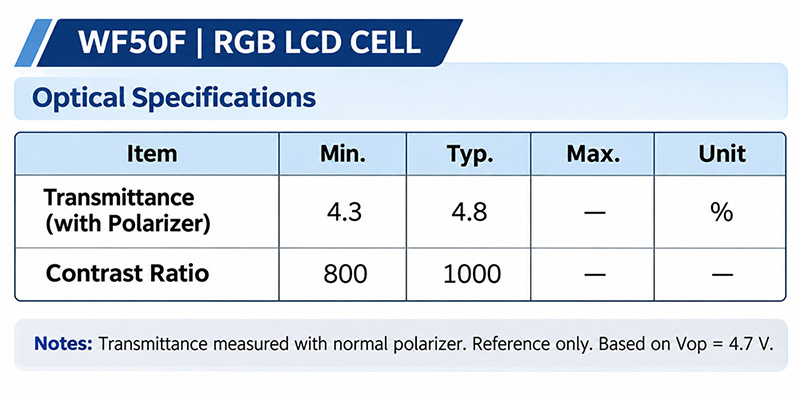
Figure 1: Optical specifications of the WF50F conventional RGB LCD cell
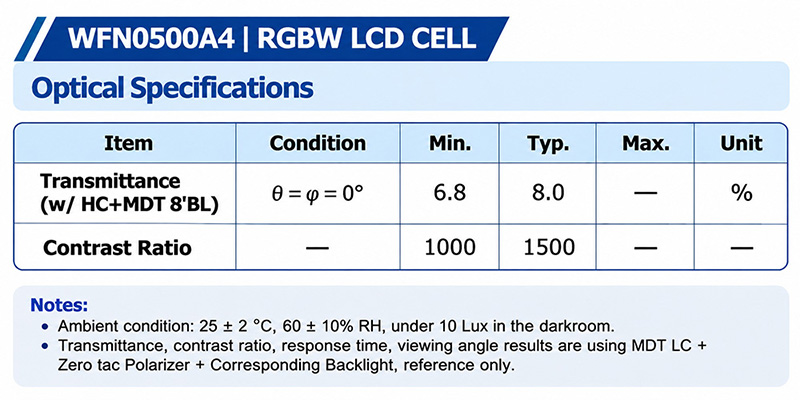
Figure 2: Optical specifications of the WFN0500A4 RGBW LCD cell
Backlight Power Consumption at Different Brightness Levels
The following table compares the backlight power consumption of the WF50F and WFN0500A4 at two brightness ranges: standard brightness and high brightness for outdoor applications. Under these conditions, the module using the RGBW LCD cell requires less backlight power.
| Brightness Requirement |
Conventional RGB (WF50F) |
RGBW (WFN0500A4) |
Backlight Power Savings |
Standard Brightness
(300–400 cd/m²) |
1.152 W |
0.42 W |
63.5% |
High Brightness for Outdoor Applications
(850–1000 cd/m²) |
1.2 W |
0.84 W |
30% |
Test Results and Engineering Analysis
- Higher Light Transmittance: The WFN0500A4 RGBW LCD cell has a typical light transmittance of 8.0%, compared with 4.8% for the conventional WF50F RGB LCD cell. Higher light transmittance allows more efficient use of the backlight, providing greater design flexibility for achieving higher display brightness or reducing backlight power consumption.
- 63.5% Backlight Power Savings at Standard Brightness: Within the brightness range of 300–400 cd/m², the RGBW module consumes 0.42 W of backlight power, compared with 1.152 W for the conventional RGB module, representing a reduction of approximately 63.5%. For equipment that operates continuously or for extended periods, lower backlight power consumption helps reduce the energy consumption of the display module.
- 30% Backlight Power Savings at Outdoor High-Brightness Levels: Within the high-brightness range of 850–1000 cd/m², the RGBW module consumes 0.84 W of backlight power, compared with 1.2 W for the conventional RGB module, representing a 30% reduction. For outdoor equipment, lower backlight power consumption also helps reduce heat generation within the backlight system, easing thermal management requirements. In battery-powered equipment, it also helps reduce power demand.
Technical Advantages of RGBW LCDs for Outdoor Display Applications
- Simpler Technology Implementation in Panel Manufacturing: RGBW LCDs build on established transmissive RGB TFT LCD technology. Compared with transflective LCDs, this approach can simplify technology implementation and process adjustments for panel manufacturers.
- Color Display, High Brightness, and Lower Backlight Power Consumption: RGBW LCDs retain color display capability while using higher light transmittance to reduce the backlight power required for high-brightness operation and the associated heat generation.
WINSTAR Customization and Integration Solutions for High-Brightness Outdoor Displays
As a leading global manufacturer of industrial displays, WINSTAR provides high-performance RGBW LCD panels along with comprehensive system integration and custom development services for industrial applications:
- High-Brightness Backlight Design and Thermal Optimization: WINSTAR develops custom backlight drive solutions based on the thermal design of the customer's equipment to support stable and reliable display operation at maximum brightness.
- Optical Bonding: WINSTAR offers full optical bonding between the LCD and touch panel to eliminate the air gap, reduce reflections in outdoor environments, and help improve display clarity and impact resistance.
- Protective Cover Glass Surface Treatments: Anti-reflective (AR), anti-glare (AG), and anti-fingerprint (AF) surface treatments are available to reduce reflections, glare, and fingerprint residue during outdoor use.
- Capacitive and Resistive Touch Integration: WINSTAR offers touch integration solutions to address industrial application requirements such as gloved operation, splash resistance, and resistance to electromagnetic interference (EMI).
RGBW LCDs: Balancing High Brightness and Low Power Consumption in Outdoor Displays
When increasing the brightness of outdoor displays, engineers must also consider backlight power consumption, thermal management, and the available space within the equipment. By making more efficient use of backlight output, RGBW LCDs reduce the backlight power required to achieve the target brightness, offering greater design flexibility for high-brightness outdoor displays.
For applications such as ATMs, EV charging stations, outdoor information displays, and handheld industrial instruments, WINSTAR helps customers evaluate the suitability of RGBW LCDs and provides display modules and custom integration solutions based on brightness requirements, power constraints, thermal conditions, and mechanical design.
If your outdoor display application presents challenges related to brightness, backlight power consumption, or thermal management, contact WINSTAR to discuss RGBW LCD module selection and custom integration requirements.
Contact WINSTAR to Discuss Your Display Design Requirements