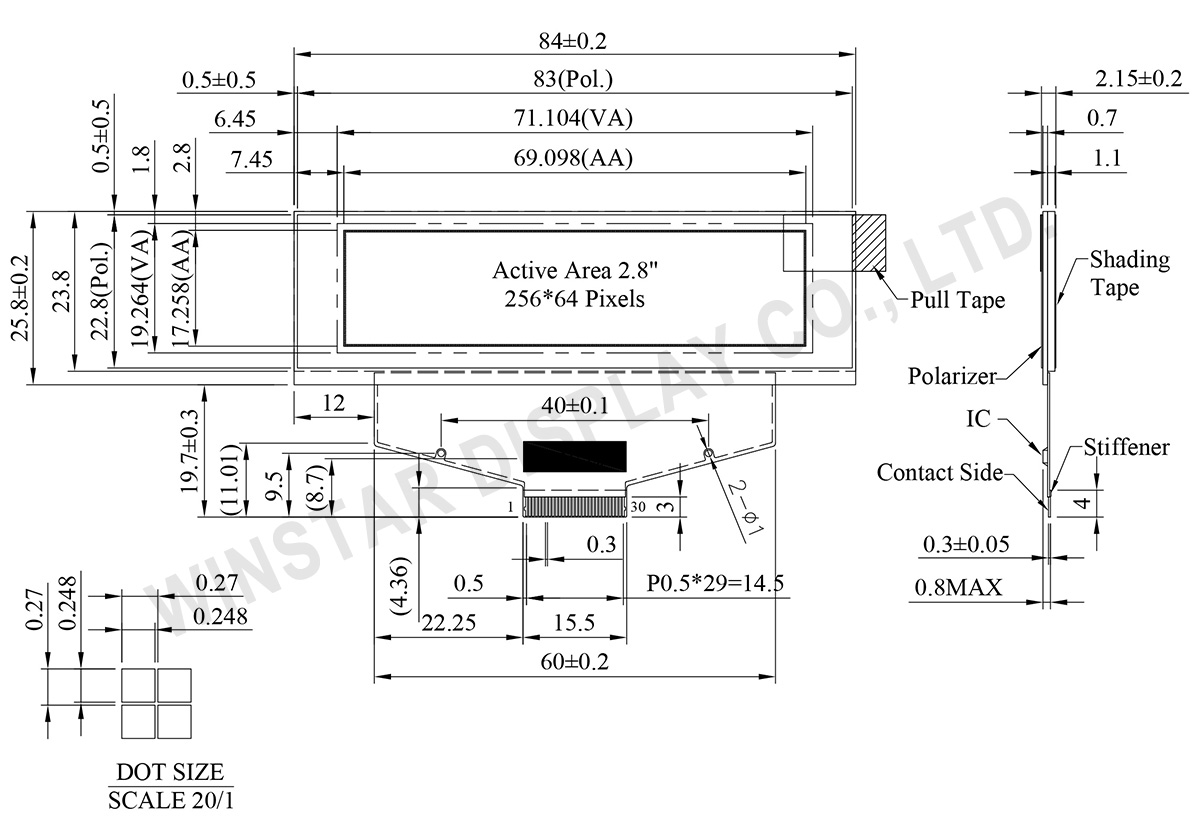
| Pin Number |
Símbolo |
I/O |
Función |
| Power Supply |
| 26 |
VCI |
P |
Power Supply for Operation
This is a voltage supply pin. It must be connected to external source & always be equal to or higher than VDD & VDDIO. |
| 25 |
VDD |
P |
Power Supply for Core Logic Circuit
This is a voltage supply pin. It can be supplied externally (within the range of 2.4~2.6V) or regulated internally from VCI. A capacitor should be connected between this pin & VSS under all circumstances. |
| 24 |
VDDIO |
P |
Power Supply for I/O Pin
This pin is a power supply pin of I/O buffer. It should be connected to VDD or external source. All I/O signal should have VIH reference to VDDIO. When I/O signal pins (BS0~BS1, D0~D7, control signals…) pull high, they should be connected to VDDIO. |
| 2 |
VSS |
P |
Ground of Logic Circuit
This is a ground pin. It also acts as a reference for the logic pins. It must be connected to external ground. |
| 3,29 |
VCC |
P |
Power Supply for OLED Panel
These are the most positive voltage supply pin of the chip. They must be connected to external source. |
| 5,28 |
VLSS |
P |
Ground of Analog Circuit
These are the analog ground pins. They should be connected to VSS externally. |
| Driver |
| 22 |
IREF |
I |
Current Reference for Brightness Adjustment
This pin is segment current reference pin. A resistor should be connected between this pin and VSS. Set the current lower than 10uA. |
| 4 |
VCOMH |
P |
Voltage Output High Level for COM Signal
This pin is the input pin for the voltage output high level for COM signals. A tantalum capacitor should be connected between this pin and VSS. |
| 27 |
VSL |
P |
Voltage Output Low Level for SEG Signal
This is segment voltage reference pin.
When external VSL is not used, this pin should be left open.
When external VSL is used, this pin should connect with resistor and diode to ground. |
| Testing Pads |
| 21 |
FR |
O |
This pin is No Connection pins. Nothing should be connected to this pin. This pin should be left open individually. |
| 16 |
BS0 |
I |
Communicating Protocol Select
These pins are MCU interface selection input. See the following table:
| |
BS0 |
BS1 |
| 3-wire SPI |
1 |
0 |
| 4-wire SPI |
0 |
0 |
| 8-bit 68XX Parallel |
1 |
1 |
| 8-bit 80XX Parallel |
0 |
1 |
|
| 17 |
BS1 |
| 20 |
RES# |
I |
Power Reset for Controller and Driver
This pin is reset signal input. When the pin is low, initialization of the chip is executed. |
| 19 |
CS# |
I |
Chip Select
This pin is the chip select input. The chip is enabled for MCU communication only when CS# is pulled low. |
| 18 |
D/C# |
I |
Data/Command Control
This pin is Data/Command control pin. When the pin is pulled high, the input at D7~D0 is treated as display data.
When the pin is pulled low, the input at D7~D0 will be transferred to the command register. For detail relationship to MCU interface signals, please refer to the Timing Characteristics Diagrams. |
| 14 |
E/RD# |
I |
Read/Write Enable or Read
This pin is MCU interface input. When interfacing to a 68XX-series microprocessor, this pin will be used as the Enable (E) signal. Read/write operation is initiated when this pin is pulled high and the CS# is pulled low.
When connecting to an 80XX-microprocessor, this pin receives the Read (RD#) signal. Data read operation is initiated when this pin is pulled low and CS# is pulled low.
When serial mode is selected, this pin must be connected to VSS. |
| 15 |
R/W# |
I |
Read/Write Select or Write
This pin is MCU interface input. When interfacing to a 68XX-series microprocessor, this pin will be used as Read/Write (R/W#) selection input. Pull this pin to “High” for read mode and pull it to “Low” for write mode.
When 80XX interface mode is selected, this pin will be the Write (WR#) input. Data write operation is initiated when this pin is pulled low and the CS# is pulled low.
When serial mode is selected, this pin must be connected to VSS. |
| 6~13 |
D7~D0 |
I/O |
Host Data Input/Output Bus
These pins are 8-bit bi-directional data bus to be connected to the microprocessor’s data bus. When serial mode is selected, D1 will be the serial data input SDIN and D0 will be the serial clock input SCLK.
Unused pins must be connected to VSS except for D2 in serial mode. |
| Reserve |
| 23 |
N.C. |
- |
Reserved Pin
The N.C. pin between function pins are reserved for compatible and flexible design. |
| 1,30 |
N.C. (GND) |
- |
Reserved Pin (Supporting Pin)
The supporting pins can reduce the influences from stresses on the function pins. These pins must be connected to external ground. |