




March 2026 WINSTAR News
Welcome to the March 2026 edition of the WINSTAR Newsletter.
In this issue, we share highlights from Embedded World 2026, introduce our STM32-based HMI development boards, present a display solution featuring STN monochrome LCD modules, and explore a technical article on MIPI DSI compatibility and timing mechanisms in display system integration.
- Continue reading for the latest updates, display solutions, and technical insights:
- › Embedded World 2026 Highlights
- › STM32-Based HMI Development Boards (2.4", 4.3", 5")
- › STN Monochrome LCD Display Solutions
- › MIPI DSI Compatibility and Timing in Display Integration
Thank You for Visiting WINSTAR at Embedded World 2026
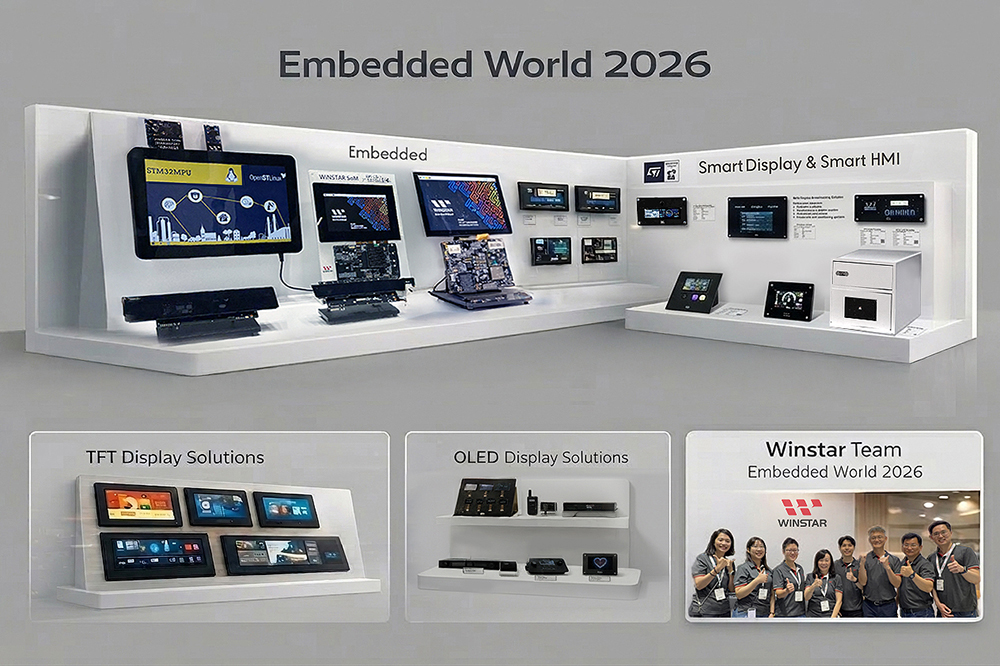
Embedded World 2026 brought together engineers, customers, and partners from around the world, creating a great opportunity to exchange ideas on display technologies and embedded system applications.
Visitors explored a wide range of solutions at the WINSTAR booth, including Smart Displays with GUI Builder, Embedded SoM platforms, rugged TFT displays, waterproof displays with glove touch support, local dimming technology, and interactive demos featuring real-time detection.
As an ST Authorized Partner and STM32 ecosystem partner, WINSTAR also collaborated with ST to showcase an AI-driven display demo across both booths. The demo featured an 8.8-inch bar-type display powered by STM32N6 with camera-based AI detection running at high frame rates.
We also presented eco-friendly display technologies, including EPD, MIP, OLED, and transparent OLED displays.
Watch the Embedded World 2026 highlights video to revisit moments from the show.

STM32 HMI Development Boards for Rapid UI Prototyping
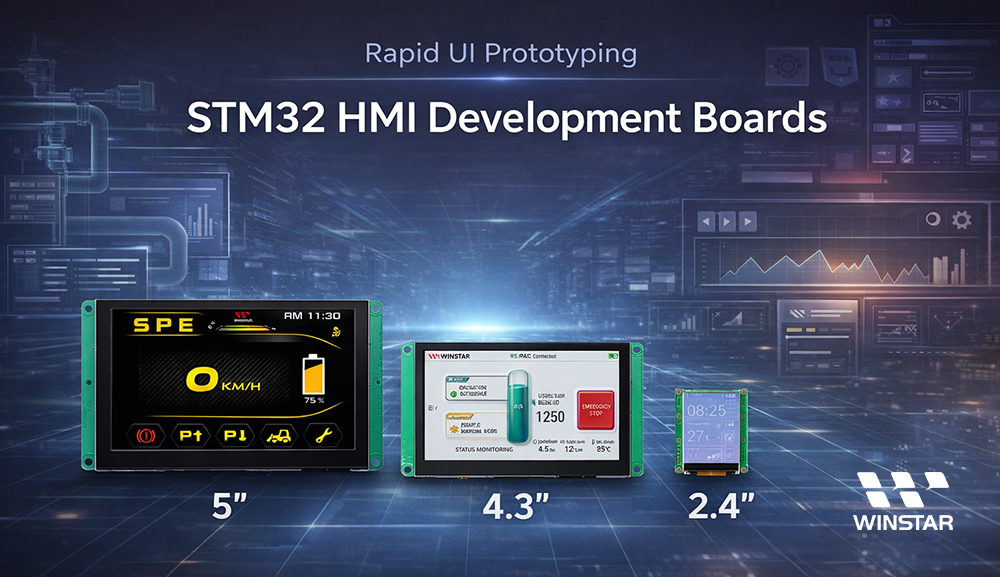
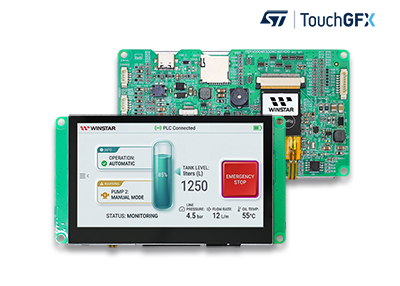
WINSTAR introduces a new series of STM32-based HMI development boards designed to accelerate graphical user interface development for embedded systems. By integrating WINSTAR TFT LCD modules with STM32 microcontrollers on a dedicated hardware platform, these development boards provide engineers with a ready-to-use environment for rapid prototyping, GUI design, and system evaluation.
The platform is fully compatible with the STM32 development ecosystem, including TouchGFX, STM32CubeMX, STM32CubeIDE, and STM32CubeProgrammer. Developers can efficiently design graphical interfaces, configure peripherals, and implement embedded applications while leveraging the widely adopted STM32 development tools.
With flexible hardware connectivity including USB Type-C, UART, SPI, I²C, RS-485, and Micro SD expansion, the boards can be easily integrated with sensors, controllers, and communication modules during application development. This makes them suitable for building industrial control panels, smart appliances, medical equipment interfaces, and other embedded HMI systems.
The series includes three newly released display sizes. It covers both cost-effective UART-based HMI control and advanced GUI development platforms built on the STM32G0 and STM32U599 MCU with GPU acceleration.
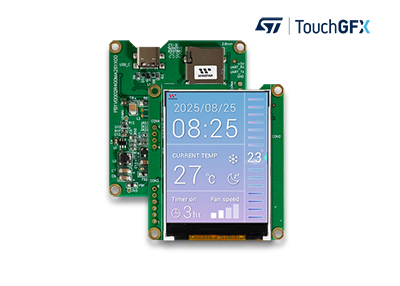 |
2.4-inch HMI Development BoardModel No.: WL0F00024000MNFAANA00
|
4.3-inch HMI Development BoardModel No.: WL0F00043000WGXAANA00
|
 |
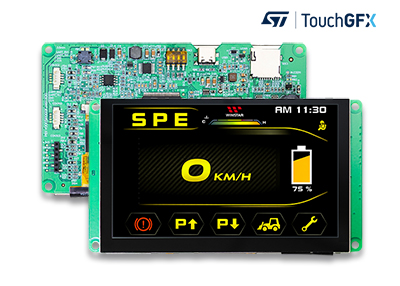 |
5-inch HMI Development BoardModel No.: WL0F00050000FGXAANA00
|
STN Monochrome LCD Display Solutions
WINSTAR STN monochrome LCD display modules provide a highly stable and cost-efficient solution for industrial information displays. With advantages including high contrast, low power consumption, wide operating temperature ranges, and excellent reliability in harsh environments, STN LCD technology remains a trusted choice for long-lifecycle embedded systems.
Backed by decades of manufacturing experience, WINSTAR offers both standard modules and fully customized STN LCD solutions, helping customers achieve stable visual performance across a wide range of industrial and commercial applications.
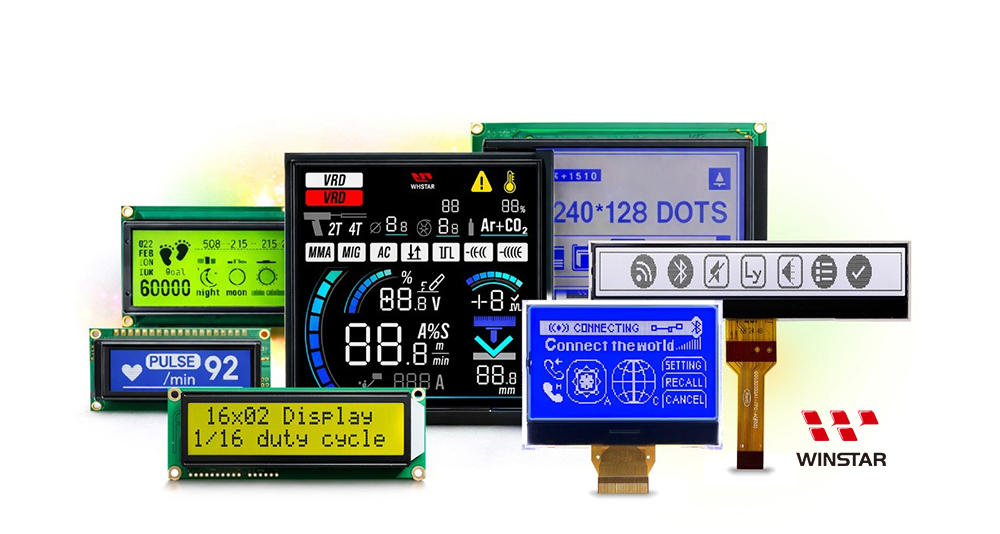
WINSTAR STN monochrome LCD display modules
Monochrome LCD Technology Options
To meet different requirements for contrast, viewing angles, and visual clarity, WINSTAR provides multiple monochrome LCD technologies:
- TN (Twisted Nematic) – A cost-effective solution suitable for basic numeric and segment displays.
- STN (Super Twisted Nematic) – Provides wider viewing angles and improved contrast compared to TN, supporting more complex graphical information.
- FSTN (Film-Compensated STN) – Reduces color shift and enhances black-and-white contrast for improved readability.
- DFSTN (Double Film-Compensated STN) – Minimizes background light leakage, delivering higher contrast and deeper black backgrounds.
- VATN (Vertical Alignment TN) – Offers ultra-high contrast and excellent viewing angles for high-end monochrome display applications.
Typical Application Areas
WINSTAR STN LCD modules are widely used in applications requiring stable performance and long product lifecycles:
- Industrial control systems and instrumentation
- Medical electronic equipment
- POS terminals and commercial devices
- Consumer electronics and smart appliances
- Fitness equipment and portable devices
View Full STN LCD Display Solutions
MIPI DSI Compatibility and Timing in Display Integration
In display product development and system integration, initialization failure or unstable display behavior may still occur even when both the host SoC and the display driver IC (DDIC) are specified as MIPI DSI compliant.
Typical symptoms include black screens, intermittent vertical noise lines, or inconsistent display stability across different hardware platforms. In many cases, the root cause is not protocol-level incompatibility, but insufficient D-PHY timing margin during LP-to-HS transition.
Practical integration experience shows that if physical layer behavior and system boundary conditions are not evaluated early in the design stage, integration risks may still remain even when the panel fully complies with the MIPI specification.
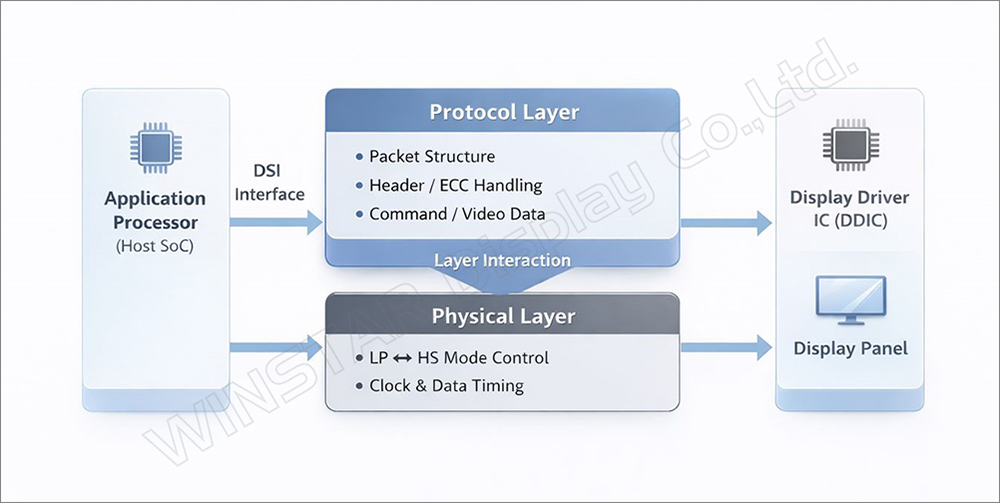
MIPI DSI system-level architecture and layer interaction
Key Engineering Considerations
- PHY and protocol layers must be evaluated together during display system integration.
- LP-to-HS transition timing directly affects SoT detection and packet synchronization.
- Meeting the minimum specification does not always guarantee stable cross-platform operation.
- Platform differences in PHY design, PLL behavior, and receiver timing mechanisms can significantly affect real-world compatibility.
Through cross-platform MIPI DSI bring-up and validation projects, WINSTAR has observed that receiver startup behavior, timing margin, and packet integrity all play a critical role in display stability.
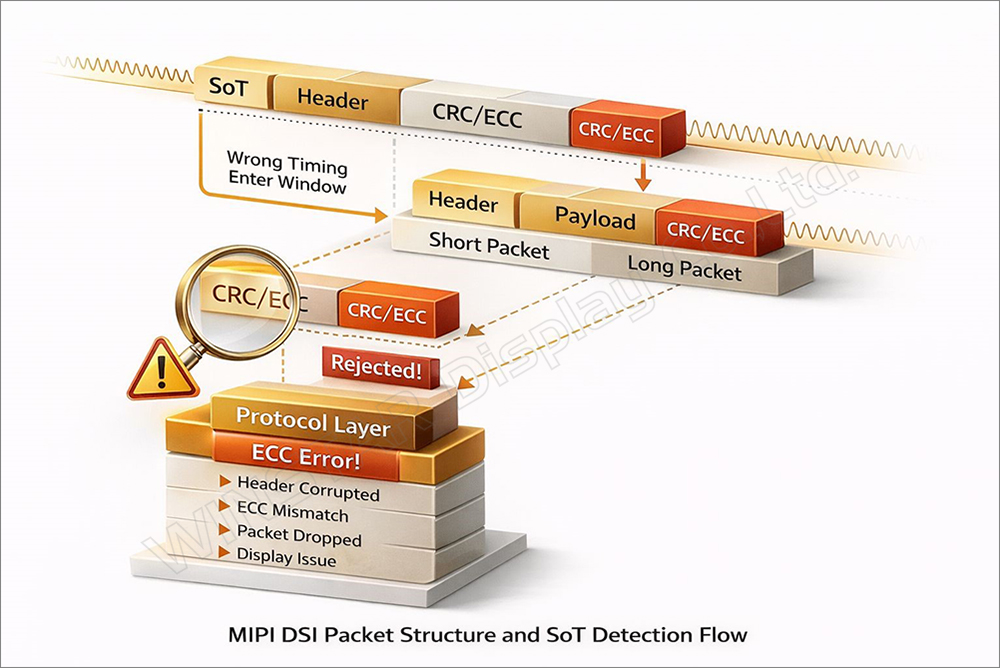
MIPI DSI packet structure and SoT detection flow
Read the Full MIPI DSI Technical Article